Showing posts with label In the works. Show all posts

Sunday, March 6, 2022

Experimenting!


Backside of the Wasatch

6" x 4"

Mixed media


I’m using art muscles I haven’t used for a while; I’m revisiting woodcuts and experimenting with color.

Relief prints are a different animal and there are a few hills to climb on the return to this medium. But they are fun—and part of that fun is the unpredictability because of all the variables between the idea and completion.

When working in black and white, you have to think differently about how you will render your subject. What will be black, what will be white, and what’s in between? Color, is another, entirely different approach.

Rather than approach things in a fashion to get my woodcut legs under me again, I jumped right in. For my first attempt, the drawing was too complicated. I was excited go right to color, but I didn’t have my head in the woodcut game yet.

Aside from the part where you carve the image into wood (and not cut out the wrong spot), there is the challenge of inking the block with the right amount of ink and finding the right paper dampness that will give you a good print. I had several blobby messes and I’m still working it out.

I was able to salvage one of the prints by going over it with colored pencil. That's the image at the top.

After the first catastrophe, I threw my enthusiasm in reverse and decided to focus on a simpler image first printed in black only. I think it came out pretty well…
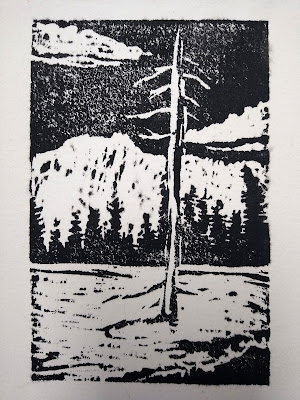

Then, I started experimenting with color again, and as with my first effort, I attempted to ink portions of the block with different colors. This is not particularly easy with a 4” x 6” image. Again, this resulted in several messes and I determined I needed to take another. However, I thought one of the results was kind of interesting even if the colors were miss-registered.
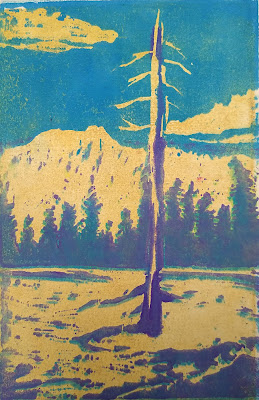


Next, I’m trying what is known as an extractive method, where in the end, the wood block is destroyed as you cut away the sections you no longer wish to print. We'll see how that goes...


Thursday, August 23, 2012

Only the Shadow Knows


Here is a snippet of the painting. 
As you see, the shadow is very dark--too dark!
Can you see my frustration in the brushwork?


Work on California Dreaming continues, though the painting has taken a turn on me (like I had nothing to do with it). I'm not sure where the piece will go next. It’s that darn shadow. I'm struggling to nail down the right colors and values and I haven't found the magic combination.

All these years of mixing paint you'd think I would have figured it out by now. Yet more often than not, finding the right color and value is akin to herding cats. What makes it so difficult? Color is affected by surrounding color. You can mix up a shade of “shadowish” on your palette that looks perfect, but once you put brush to canvas it’s suddenly too dark, too light, too green, too gray, or some other color catastrophe.

Coincidentally I watched my student Morgan struggle with the same thing this week. Studiously she mixed and mixed—serious brow furrow in place—adding a dab of blue, a dribble of medium, a little more cadmium red, a touch of white. Her shoulders relaxed as she achieved the perfect color. She smiled and moved the brush to the canvas to place the perfect glob of paint.

“OH!”

Big sigh. "That's not what I wanted!"

Mix, mix, smear, scrape, mix, wipe, rinse, swirl.

“There! That’s much lighter.” Confidently she dabbed the canvas with the amended color.

“OH!”

“That looks almost the same as the last color!”

After about the fourth “OH!” we started to laugh about it. Finally, she found what she was looking for.

At one point I told her, "Mix it beyond what you think you is right. Make it lighter, darker, cooler, or warmer."

Hmmm. Maybe I should follow my own advice.

Wednesday, August 15, 2012

California Dreaming

­
"TBD"
Just a few hours into a new painting
24" X 18"
Acrylic on canvas


Stealing time to paint has been a challenge lately. The urge is strong and the studio is a siren singing me back to this painting. I return for a moment here and there to look at it. I yearn to squeeze out just a little color—please just a little—and grab a brush—just for a little bit—but it seems there’s always something else that needs done, someone else I have to call, again.

My dreams are filled with colors laid against one another and elements rearranged over and over. I’m analyzing value and composition of dream paintings that are never quite the one I’m working on. I’m anxious about mixing colors. Warmer? No, cooler, with maybe a touch of alizarin. I’m not resting because my mind is busy painting.

Even though I just started this piece, I wanted to share what I have so far. We’ll see how it develops together. This image is from a trip we took last summer when we explored the area around Domeland Wilderness, pre-planning for our fall backpack trip.

Out west of Kennedy Meadows and northeast of Kernville there is a swathe of old and classic California.  Rolling hills dressed in velvety grasses bleached gold in the hot summer sun. A narrow road cuts and curves around ancient oaks with dense canopies of leaves that cast deep shadows.

Do you hear that? My studio calls.


Thursday, May 10, 2012

Saturday, February 4, 2012

The Sycamore Saga


The original sketch
In November, we took our belated honeymoon. We spent time a lot of time between Flagstaff and Durango exploring pueblo ruins, desert mesas, and mountains that are very different than our San Gabriels. I can’t wait to go back. There were places with a spirit and vibration that was unlike anything I've experienced before.

As we worked our way homeward, we stopped south of Sedona to camp for a couple nights at Wet Beaver Creek (yes, that’s the real name). We had a lovely spot along an olive green creek framed by sycamores hung with glowing yellow, gold, and bronze leaves. Their trunks of creamy flesh curved upward like slender elfin creatures. These trees looked as though they were frozen mid-dance in a graceful tableau.

I’ve been struggling to capture this grace, starting first with a monoprint that was a miserable failure. It looked more like a Rorschach inkblot than any kind of recognizable image. 

I moved on to watercolor, but that came out too heavy-handed and didn't reflect the shapely form that initially attracted me. The leaves were nothing like the golden mantel draped over the limbs. Although the painting might be salvageable with a little more work, I decided it was time to move on to acrylic.


The watercolor...meh
 So, here I am, again sharing something unfinished. This is risky, because it may not turn out. It may end up being a do-over. It’s too early to tell. Yet pulling aside the curtain to share my adventures in art—even when things don't turn out as planned—allows you see that it’s not always as easy as it might appear to be. The “struggle” in struggling artist has many meanings.

The acrylic version. I'm not too far along yet, so it's too soon to tell if this will be a keeper.

Friday, January 13, 2012

Getting There


I am transported when I paint. There are two activities going on in my head as I push and dab and smear the paint around on the canvas. One is a running patter about technique and color...no that's too red, this shape is too thick, yes, that's the right value, I need another glaze of blue...

The other is the sensory equivalent to being there. I'm standing on that ridge, my cheeks cold in the pre-dawn air, I smell the campfire, and listen to the ravens calling, "Good morning".

I escape. I've done this since I was about 13, when I would recoil into my room from a world that was nothing like the books, magazines, or television shows. Teenage-dom for me, like a lot of people, was no picnic. One of my escapes was painting. I devoured National Geographic magazines for subject matter, and I'd go to those places when I painted them.


When I was fifteen, a magical thing happened that changed my life. My uncle and aunt arranged a summer job for me in Yosemite. It was like going to heaven for 3 months. When I'd leave, all I could think about was when I was there—and when I was going back. Going home. That’s how I thought of it. In between those summers, the out-of-body travel became more a more frequent occurrence. I retracted like a raw nerve from my surroundings. I had three glorious summers there that got me through high school, kept me from jumping off a roof.

For some reason, when I was working on this image from Domeland it made me think about that time in my life. There was one painting in particular I remember that I worked on for a long time—until it was perfect. It was a beautiful, gnarled tree, stark against an electric blue sky. After each painting session, it was as though I slowly awakened from a vivid dream. Then it struck me why this memory came to the surface: the tree in that painting looked like many of the weathered trees in Domeland.

Painting isn't just about getting there in terms of finishing a piece, it’s also the way I mentally and emotionally return to the source of my inspiration: the wild places, the places I love best.


Now for the update on the painting: I'm getting there, in fact I'm really close. I just need to make the foreground become the same place as the background. The warmth of the sun peeking over the ridge and the light on the grassy hill rolling down into the meadow is not quite where I want it to be.

If the art gods smile down on me, this weekend I'll finish it and start another piece. What next? Maybe back to making monoprints...I have an image of a sinuous sycamore that's been hanging out in my head.

PS. This is my fiftieth blog post. Yay me.

Friday, January 6, 2012

Return to Domeland


It’s time to go back to Domeland. The wilderness area no one’s heard of tucked between places that sound vaguely familiar. I have to dig deep to recall exactly where it is...somewhere near Brigadoon, I think.

What I do remember is its beauty and wildness—and the fun we had—the four amigos. I still laugh remembering as one of our hiking party—who shall remain nameless—high stepped like a cartoon character, legs-a-spinning as he hightailed it down the trail away from a very pissed off rattlesnake who’s sunning was disturbed. Funny? Yes, if you weren’t the one running.


Domeland feels like a secret place where somehow you’ve been lucky enough to gain entrance. You can hear yourself breathe there and feel the spirit of the place—its trees, rocks, and wildlife.

From a painter's perspective, the Domeland is a Maxfield Parrish painting. It’s saturated and oozing and dripping with color and contrast.

So, what to paint next? I had one more of those special canvases I fell in love with and an image of the sun first lighting the meadow—the perfect subject. I broke out the new brushes and acrylics, in hopes of achieving rich and brilliant color pushed to the point of surreal—just like I like it!

This painting is early in the process, not much more than an underpainting—so together we’ll see where this goes.


Friday, December 9, 2011

I Draw Everything But Flies

  
I think I first knew I wanted to be an artist when I was in second grade. When I finished coloring the cornucopia the teacher had mimeographed on the construction-paper cover of our Thanksgiving “What I'm Thankful For” booklet, I was quite impressed by my use of color and careful outlining of each component. It was so lovely, I wrote on the cover, just below the image: “For Sale”. I was thinking I could get about four bucks for it.

A few years later, when I was about 11, while working on my Animals in Pastel series, brightly colored cartoon-like images that flouted the conventions of realistic color, I declared to my parents that I was going to be an artist. My dad had a big grin on his face and said, “I have the perfect slogan to put on your signs.”

As soon as he said that, I knew it was going to be something embarrassing—or horrifying, or scary, or disgusting. I was an extremely sensitive child—overly so—I’m sure my family would say. My dad was an earthy, salty guy who came from the wrong side of the tracks as a kid. He didn’t pull any punches and called a spade a spade. Although I loved him dearly, he was a constant source of mortification for me. I never knew what he was going to say next—or to whom.

“I draw everything but flies,” he said, after a dramatic pause. Of course he was teasing, but I was beside myself. “Dad, I can't put that on my signs. That’s weird!”

The consummate salesman, he proceeded to outline the benefits of such a clever saying. I squirmed and murmured something acquiescent, but inside, I was not convinced, and determined that I would find a way to NOT show him my signs, which would NOT be tarnished by such a crude slogan.


And so today, I do pretty much draw everything but flies (having grown up terrified that if I did not bathe frequently enough, that prophecy would come true). Although most of the works I’ve shared with you are paintings, often there is a great deal of drawing that goes on in the development of a piece.

Drawing is the way to figure things out, understand the shapes, the light, and relationship of the two to one another. Drawing helps me figure out my composition and often leads me to the medium I will choose. In the background as I sketch, I’m thinking about which method and medium will take me where I want to go. Do I want to push around acrylic paint to create texture, flow brilliant transparent color across a page, or scrape away ink from a plate to create a less refined image?


There are times when the drawing stage is very short. I know exactly where I want to go and with which medium. Other times, I'm drawing and re-drawing for a while until finally, I feel I'm ready to move to the next step. Occasionally, I get stuck mid-painting, and have to stop to do another drawing to work out the problem spot.


Here's my current study, a boot someone slipped over a post on a gate at a cemetery out in the middle of nowhere. It seemed like a funny place to leave a boot, that's for sure. Once upon a time it wasn't nowhere; it was the Kern County Seat. Now it’s just a wide place in the road, known as Havilah. It's in the mountains between Bakersfield and Tehachapi along a road that winds through classic California hills sprinkled with oaks.

I’m not sure where I’m going with this yet, but when I get there, I’ll share it with you.

Friday, November 25, 2011

Blowing on the Coals

Beneath the Willows
Watercolor + Ink
9" X 12"

Coming back to a painting that's gone cold is like coming back to a plate of food after a long unexpected but important phone call has interrupted your dinner. The enthusiasm when you first sat down is lost when you return to the once appealing, now congealing meal.
 
Nonetheless, one has to give it the old college try—especially when you have a promising start on a piece. It's always fun to start a painting, but when time is short and you are dealing with the distractions that come with plein-air painting (like bugs, wind, and darkness), you are sometimes forced to set a piece aside before it's well established. That’s what happened here. It was cool, windy, and the sun was going down—so it was getting colder. I had to call it quits because I was shivering and my bottom was getting numb from sitting on the damp soil.

This piece was beyond cold. It was a dry, shrunken crust on the creative dinner plate. I won’t even show you the before painting, because it is so different from the result. The piece started out loose and filled with rich, warm colors. It became cooler upon my return to it—literally and figuratively. I found myself reaching back through thick cobwebs to remember the color and the value that I had not quite captured. I tried to put myself back into the mood of the place and recapture what first inspired me to sit in that spot beneath the willows at Lone Pine Creek.

I’m not sure that this painting will make the final cut, but I thought I would share it anyway. A little view behind the curtain at one of the pieces I’m not sure I would call a success. I’ll put it away and look at it again in a month or two, though it may end up in the collage pile. We’ll see.

I hope this does not portend another dry spell, because I’ve plenty of inspiring photos to work from after our recent trips. I guess I’m not sure what I want to do next. I’ll just have to head up to the studio and see where my art takes me next.

Friday, September 9, 2011

The Joy of Blank


“Writing is easy. All you do is sit staring at a blank sheet of paper until drops of blood form on your forehead.” 


So true. Although it’s not like that when it comes to making art. A blank sheet on the art table stirs a thrill in me akin to that moment of free fall on a roller coaster. Whether it is a fresh, bouncy canvas or a crisp sheet of watercolor paper, there is something exhilarating about starting a new piece.

That beautiful blank surface urges me on. I think about the brush dragging across the surface, the paint pooling, the smell of sizing as it’s released by water.

The excitement is killing me. But I don’t give in to the temptation. First, I visualize the subject on the surface and consider placement. Do I want to push the focal point to one side or the other? Higher or lower? What is the mood I want to project? Am I feeling soothing green or high-energy orange? How will the surface texture affect my painting?

When I start to twitch then it is time to draw the subject onto the surface. With watercolor paper, you must have a fairy-light touch so you don't spoil the pristine white of the paper. You have to KNOW your subject before you make a mark, for this surface is unforgiving. Get carried away and go too dark with your pencil—or misjudge your position—and it’s all over. You’ve destroyed a beautiful, innocent, expensive piece of virgin paper. (I love paper, by the way. In case you haven’t noticed, I kind of have a paper fetish.)

With canvases, it’s a little less critical with the drawing because acrylic paint covers better. Although it still requires a light touch to avoid muddying the first layers of color with smears of graphite.


Then, the moment I’ve been waiting for arrives. The first layer of paint goes on. Ahhhhhhhhhhhh. There is nothing like that first disturbance, breaking the surface tension and sizing with just the right mix of pigment and water. I lay in transparent color to create the under painting, the texture and light of the white surface beaming through the pigment in these first moments is exhilarating. The best, most exciting thing in the world is if some of these initial layers are left to shine through the final painting. It’s magic.

What is all this gushing about surfaces? I must confess I am in love with a new canvas. I haven’t been this excited about a surface in a while (well, there was that fling with gelatin plates, for which I still long). This new canvas is beautiful and supple and bouncy; perfectly stretched over wood strips that aren't warped or splintery, not a pucker to be found. Most of the canvases I’ve bought in recent years are dry and scratchy like an old cracker—though crackers tend to be more square rather than parallelogram shaped.

On my new love, the paint flows on the surface, the rhythmic texture of the canvas enhances without overpowering. It takes the colors softly, allowing me to build gentle layers of subtlety. It’s heavenly painting on this surface. Pure heaven!

And it’s all because we decided to go back to a place that I wasn't even sure still existed.

Last weekend, in desperation to find good frames, we drove out to a shop where I used to have most of my work framed. I hadn’t been there in 10 years and I can’t believe I ever stopped going there. Aside from the great selection of frames, awesome service, and reasonable prices (can you tell my day job is writing marketing propaganda?), I’d forgotten about the beautiful stretched canvases he makes—excellent, supple, inspiring canvases. 


I can’t even begin to express how the surface stimulated me. Yes, I know that sounds wacky, but working on this surface is so…arousing!

I hope to finish this painting over the weekend. It’s 18" X 24", so it's taking a bit longer. I’m truly enjoying the journey with this delightful canvas.

For those of you wondering about this shop, I want to give them a plug: Leon Picture Framing in Anaheim, California. The owner is a great guy who believes in quality and giving his customers great service. I’m so glad he is still around and doing what he does so well. See Tim and tell him Susan sent you.

I can’t wait to go back and get more canvases. Oh and, while we were there, we picked out a couple frames too. The pieces look great. I can’t wait until you see them!

Saturday, June 11, 2011

The Last Impressions


Remembering Fall
Monoprint, 11" X 14"


As my first gelatin plate was starting to disintegrate, I decided to try a print using natural materials. One of the interesting (and fun!) aspects of gelatin printmaking is that it lends itself to the use of all kinds of materials (the flatter, the better) to incorporate shapes and textures into pieces. The fluidity of the paint and the soft surface of the gelatin allow the capture of a thrilling amount of detail (yes, my world is small).

First, I painted the plate and laid the leaves and sprigs of lavender on top. The resulting print left open silhouettes where the materials blocked the transfer of the paint. I removed the leaves and reprinted. The impression the objects left in the paint during the first round was then transferred to the paper. Although I missed my registration, I liked the texture and detail it added.

Next, I overprinted the darker colors. I used a brayer to spread an even coat of color onto the plate. This method creates a different texture than when the paint is brushed onto the plate.


For the last print, I tried a small bundle of lavender, which in its bulkiness completed the destruction of the plate. I wouldn't exactly call it a success, but it's definitely a contribution to the learning process.

And, I’ve learned a lot. The second gelatin plate tore in to pieces after only two prints. Large dry areas on the plate tend to stick to the receiving paper (whoops). I have also discovered my gelatin to water ratio was incorrect. Math. Grrrr.

However, I am not discouraged. Sweet husband is going to cut me another piece of Plexiglas so I can set up two plates at a time to extend the creative frenzy (oh goody!). I can’t wait.

Monday, May 30, 2011

Adventures in Gelatin


I'm trying something new: gelatin monoprints. Yep, prints made from a plate of gelatin—as in J-E-L-L-O—only using the unflavored type of gelatin. I've had a book on this technique for a while, but it requires some preparation before you begin the art part. Warning: If you are considering trying this, you should know there will be yucky, boogery globules of gelatin everywhere.

First, it calls for a piece of Plexiglas that serves as the surface for the gelatin plate. Next, you create a frame out of modeling clay. The frame holds the gelatin, which is dissolved in warm water and then poured onto the plate. You must be sure there is a good seal so you don’t have gelatin leaking out from underneath the clay (speaking from experience).

The surface must be level, which in this house, is a challenge. When someone says, "Please pass the salt", we turn it on its side and let it roll to them.


Here you can see where I've created my dam and leveled the surface using an assortment of shims and paper. One thing important to remember is to remove the level from the Plexiglas before you pour the gelatin onto the plate. I was so excited when I got to this point I almost forgot. I would have been in big trouble with the Toolmaster.

The gelatin is poured and must sit overnight to set up. Then, the clay is removed, leaving jagged edges on the gelatin plate, which is part of the charm.


Using water-based paint (watercolors, temperas, inks, etc.), you paint right on the surface of the gelatin. It's a little tricky because if the surface gets too wet, the plate dissolves. A sheet of paper is placed over the painted surface. Gently, but firmly, you rub the back of the paper to transfer the paint.


On the first print, I discovered I had not used enough paint. I painted the plate again and transferred it to the same sheet. It's easy to register the plate to the paper, so you can overprint images multiple times to experiment with layering the colors. Well, that was so much fun, I over did it, therefore, there are no successes to share of this image that started out so promising. Part of art is knowing when to stop.

I found myself caught up in the color results and obsessed with unusual texture created by the brush strokes and the plate. (BTW, if you look close you can see the globs of gelatin that came off the plate edges and on to the paper.) I tried three different kinds of paper and varying amounts of paint and water—that gelatin plate was rode hard and scraped away wet when I was finished with it.


It's going to take some time to get a good piece with this technique. For now, I'm just trying to figure it all out and see if it's going to work for me. I was thinking about this...why would an artist try something that is just going to make it more difficult to create art? I'm using paint I rarely use (semi-opaque tempera) on an unpredictable surface that reacts differently than anything I've ever worked with in the past.

When I showed Clint the results, the same thing must have been going through his head. He said, "Why are you doing this? What's the point?" Good question. Because it's a new technique that adds a new dimension to my work. Uh...because it adds surprises (good and bad) and a loose and spontaneous feel to my work…because it's fun. He wasn't convinced. He picked a chunk of gelatin out of my hair.

I think this technique may lend itself to work that is more abstracted in nature. A wilder, looser version of what you may have seen from me in the past. The next plate is curing…stay tuned.

Friday, April 1, 2011

Plein Ole Outdoor Painting


"Paintbrush"
Watercolor, 6" X 9"
I painted this on location at Spring Valley Ranch near Red Rock outside of Las Vegas.

 I'm planning to do a little plein-air work in the upcoming weeks.

"Oh," you gasp, "I love plein-air painting". I'll bet you love Impressionism too; because that's another “style” most people are familiar with. Aside from modern art (What's up with that Picasso eye-on-the-side-of-the-face thing? My kid coulda done that), Impressionism and plein-air are what most people remember or recognize among the many art styles and sub-styles throughout history.

The plein-air style—especially here in the golden state—California Plein-Air rings a bell with most folks, (although it is actually considered a variation of impressionism). Plein-air is the skinny jeans of the art world these days and is often imitated. Ubiquitous as Wal-mart, as stylized as the stick-family decal slapped on the back of every SUV, plein-air has prom queen status and is now the most sought after and miss-identified art de jour.

I'm not saying the California Plein-Air painting style is bad. Much of it is beautifully painted. The originators of the style in the 20s and 30s were masters in my mind. There is a freshness and spontaneity that is extremely exciting in a well-done on-the-spot painting.

Before it became the epic buzzword of art lovers ("I don't know art, but I LOVE plein-air"), I was hauling my pads, water bottle, palette, paints, treasured extra-soft watercolor brushes, and a bag of gummy bears in a MacWorld tote bag, hiking hill-over-dale in search of the perfect spot. Which, in addition to inspiring scenery should include: easy access to a bathroom or private bush, no ant hills, semi-dry ground, and be located far enough away to give you solitude, but not too far away to be heard if you must yell for help.

Someone! Help! Please! I can't get the cap off my Alizarin Crimson!

Give me those things, or at least most of them—location, bathroom/bush, and a bite-free place to sit—and I am the happiest girl in the world. I could sit for hours and watch the light change, listen to the birds, and paint my heart out. And I've done that a time or two hundred.

Once I sat in Devil's Punchbowl and painted the milky morning light, then the heat of noon on bleached-bone rocks, and finally, the afternoon glow of the setting sun. Aside from missing the trail and having to climb straight up over treacherous rocks (snakes!) to get back to my car, it was a perfect day.
  
I don't get the opportunity to sit outdoors and paint as often as I'd like, but when I do, it is a soul-soothing treat like no other. I'm really looking forward to this time and I’ll share what I do with you when I return.

Thursday, March 10, 2011

Back in the Saddle


I'm working on a new painting and I’m loving it.

It's a dance across a giant ballroom in a twirly gown. If there were a crowd, they'd be clapping at the grace and beauty of my execution. I’d probably be wearing a tiara. I know that sounds overly dramatic and well, kind of like I’m a swellhead, but I’m really happy and excited about what I’ve done so far. I’m intoxicated with the joy of a painting that's going well.

I know I risk great exposure here, telling you about it. What if this painting doesn’t work out as it progresses? What if I catch a heel in my skirt and fly a$$ over teakettle, my tiara skittering across the floor, spattering rhinestones in its wake? Oh well, that’s the risk I take. I live for danger, you know.

Recently, I realized that I went down the wrong path with the creek painting. Even before I started it, I had a strong urge to work with watercolor. Yet, I ignored that tug toward watercolor—and that's what started the entire mess.

Let's see if I can describe this. There are times when I approach my next art project from a sensual perspective. I think about the various media (rather than a specific subject) and how I experience each with my senses.

It might be the interplay of a soft brush whispering across paper, sweeping along the magic-magnetic tension of watercolor. Perhaps it is the crunch of a stiff brush dabbing at a canvas bouncing back in response. It could be the purity of transparent color I want, or the opacity of acrylic textured by brush strokes. Thin, thick—or a contrast of both? Do I want color granulating into the mottled crevices of paper? Shall I let the woven canvas shine through, or cover the surface in a thick impasto?

Is it the musty scent of sizing released by watercolor paper when it's wet (the more expensive the sheet, the smellier!), or the scentless sterility of a canvas board? Shall I immerse myself in the medium; spatter ink on my face, smear chalk on my forearms, or just tickle the surface with a delicate drawing?

And so, I realized I had to feed the need to explore again with watercolor. I started a painting of a cyclamen in bloom, (using one of my very special pieces of watercolor paper given to me by my sweet husband). I love the inside-out flowers—like wings fluttering above the leaves. I love the graceful forms, the brilliant color.

It was just what I needed. Ahhh, I feel so much better.